
House Concert Footage: Hello?

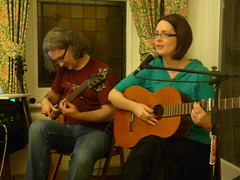
I’m SO glad that our new live mixer set up allows us to multitrack record everything. It means we can capture lil’ moments like this one, when I decided to open the House Concert in Camberley with a version of Lionel Ritchie’s ‘Hello‘.

I’d previously played it at home, but just the chord melody bit. The weirdness in the middle was a whim – I’ve blogged before about the way that the house concert set up lets you take more time over things, and more risks in your playing. Here, they paid off: Continue reading “House Concert Footage: Hello?”

“Sharing Is Not Stealing” – Cost, Value And The Desire To Share.

A few thoughts on the relationship between cost, value and the action of sharing music:

As I’ve said before, £10 was never representative of the real value in an album. It was less than the value of the time the person takes to listen to it, and certainly not anything like the value the artist places on their finished work.

And of course, given that all albums sell in different amounts, and all the cost of making the album is upfront – before anyone knows how many it’s going to sell – it couldn’t really be described in any fractional way as a share of that value.

No, it wasn’t an expression of ‘value‘, largely because the most natural way of expressing our sense of value in music is to share it. Continue reading ““Sharing Is Not Stealing” – Cost, Value And The Desire To Share.”

Third Preview Track From forthcoming Steve Lawson/Mike Outram album

So, Mike Outram and I have been releasing a new preview track each time the play-count on the previous one reaches 500 – the last two are on Souncloud, and are both past that benchmark, so we’ve made another available.

BUT.

It’s not on Soundcloud. It’s available for free in exchange for a Tweet.

Head to http://stevelawson.net/tft/ to get it. Continue reading “Third Preview Track From forthcoming Steve Lawson/Mike Outram album”

How DO Musicians Earn Online?

Social web has been buzzing these last couple of days with a visualisation by Information Is Beautiful, entitled “How Much Do Musicians Earn Online?” Click here to see it.

In case you’re not able to see the list, it’s a visual representation of how many instances of a range of online ‘music payment events’ you’d require to make a living wage solely from that service.

Not surprisingly, streaming services come out of it badly, especially when compared to sales of CDs.

However, the problem with presenting data in this way is that implicit within the list itself is the assumption of linearity: the list itself says “these are distinct events between which there is at least conceptual parity when comparing how many instances of that payment event are required to meet a particular sum.” Continue reading “How DO Musicians Earn Online?”

Spotify Is Broken: The Lie Of ‘Feels Like Free’

One of the big questions hanging over Spotify for me has been ‘do premium plays pay more than Spotify Lite plays?’ – I.E., do I get paid more if someone with a premium account plays my tunes vs. someone using the ad-funded version.

It stands to reason that the person with the premium account is paying more to listen, so surely you’d imagine that’d be reflected in the royalties?

At SXSW this year, the CEO of Spotify was giving a talk, I asked the question about royalty rates via Hugh Garry and apparently they are distributed evenly.

This is, as far as I can see, Spotify’s MASSIVE mistake. A deal-breaking, game-not-changing, screw-up of gargantuan proportions.

Here’s why.

The people best placed to promote Spotify are artists. We can link to it from our sites, we can provide links to it when we release new music, we can blog about how great it is and share music by our peers via the links.

If we push it, it becomes the place to find our music.

Spotify needs premium accounts for it to work. At the moment, their strategy for getting people signed up is to annoy the shit out of you with adverts until you capitulate. So you get irrelevant adverts that provide no value at all to the user, and therefor no value to the advertiser. Ergo, the amount paid per advert is likely to go down not up, killing the ad funded model. If I was an advertiser there’s no way I’d bother with Spotify. ‘Can you pay to produce an advert that we’re going to use to annoy people into paying not to hear it?’ no thanks.

So what would work? Spotify’s (and the other streaming services) best chance of success is if artists see it as a viable alternative to selling individual albums and tracks digitally. If it becomes that, the amount of traffic will go up and all that listening will be happening in a discovery environment, so more music will be heard by more people.

They could also make way more if the ads were something other than anti-value annoyances to be got rid of. There are loads of ways of making ads work in this setting – referrals, targeting, favouriting, user-profiles, profit-share, in-browser special offers… all kinds of stuff that would make the ad-side of the site self-supporting. If it isn’t currently viable, then the solution is to up the level of the ads even further til it is viable. The listener needs to FEEL what their listening is actually costing.

Why? Well, contrary to what Gerd Leonard has been telling us for years, ‘Feels Like Free’ is not the answer. It never has been and never will be. Free is, in fact, better than ‘feels like free’. I’d rather make my music free to download, no strings, and be rewarded in gratitude than have some weird filtered, taxation-based payment mechanism for it where people are left thinking music has neither cost nor value because there’s no tiered pricing, no opportunity to ‘pay what you like’, no thought about the value over and above the experience that access is via a portal and detached from the artist…

Listening to ads is a form of payment. We all know that. If the ads don’t cover it, then it’s a lie to keep that system going by subsidising those listens from people who are actually paying – people who are quite explicitly paying a subscription rate that puts a distinct value on their listening time. To not divide those up is to say that the value of both listens is the same. It isn’t.

  • Spotify Lite is a limited but hugely useful discovery platform. If you have the kind of life where Spotify Lite is ‘enough’, then you weren’t about to pay £10 an album for CDs anyway. You’re probably the kind of person who listens to the radio and buys the occasional compilation. Certainly not the kind of person for whom £120 a year for Spotify premium is workable.
  • Spotify Premium is an alternative to buying music. It’s also, when you look at how long people spend listening to music, a great model for paying a sensible amount per listen. If – and only if – it’s not being used to prop up a broken ad-funded ‘feels like free’ bullshit model.

If you want me to pay £10 a month for music, let me allocate where that £10 goes by choosing what I listen to. Make that £10 count, make it mean something. Cos otherwise, I’m going to stick with eMusic, where I know that my monthly sub goes to the people whose music I’m downloading. I know they get a set amount per track, that they wouldn’t get if I wasn’t paying for it. Real end to end value.

‘Til then, there’s no way on earth I’ll be paying for Spotify premium, and I won’t be encouraging anyone else to either.

If this feels like a deal-breaker to you, and you already have a premium account, you might want to consider cancelling it, and emailing Spotify to tell them why. Or better yet, blogging about why. Let’s have this discussion in public where possible.

[and before the inevitable ‘hey, I thought you loved Spotify!’ comments happen – I still think Spotify-lite is an awesome discovery tool. Spotify premium is, as yet, way too small a slice of anything to make me rethink my position on that. I don’t need to make money from Spotify-lite for its value to be realised. But the payment model that’s there doesn’t work, so the growth curve that Spotify needs to remain viable will be a seriously uphill struggle.]

My letter to the Musicians Union About the Digital Economy Bill

Well, the Digital Economy Bill passed. One of the stupidest yet most potentially catastrophic bits of legislation ever forced through in the Wash-Up (the last couple of days of a Parliament before an election.

I opposed it, I still oppose it and I will continue to oppose any legislation about the internet written by people who don’t understand the internet or, in this case, the music industries and the role that music plays in our culture.

I’m particularly ashamed that the Musicians Union – a Union of which I am a member, was a proud member, and have supported by paying double what I should’ve been paying for the last two years – supported this insane bill, to the detriment of musicians everywhere.

I made this public, and got an email of their ‘official position’ this morning, which is: Continue reading “My letter to the Musicians Union About the Digital Economy Bill”

Annotating Tracks With Soundcloud

As promised, when the 1st of the Steve Lawson/Mike Outram tracks reached 500 plays, we uploaded another one. It’s a really long one that goes through 3 or 4 very different sections, though that evolve on into the next in a lovely fluid way. In order to explain a little of what’s actually going on (it’s a pretty big noise for just a bassist and a guitarist to make live!) I’ve annotated the track, as you can see below. Continue reading “Annotating Tracks With Soundcloud”

Web Stats for musicians: Lies, Damned Lies and Google Analytics.

So, you’ve taken the advice and started blogging. You’ve put your music up on Bandcamp for ‘pay what you want’ download. You’re chatting to your audience, friends and fellow musicians on Twitter and Facebook. Now you want to be able to measure how much impact all this stuff is having, right?

Almost all web-hosting comes with some kind of statistics option for tracking how many people are visiting your website, and what they are doing. The most widely used 3rd party option is Google Analytics, which is available to be added to any website (and particularly easily integrates with publishing packages like WordPress and Moveable Type). Continue reading “Web Stats for musicians: Lies, Damned Lies and Google Analytics.”

© 2008 Steve Lawson and developed by Pretentia. | login

Top