28th Anniversary of This Website, Now Updated!

Using the anniversary of the start of my website as an excuse for a bit of a history lesson in websites, blogging and algorithms. I suspect this is part 1 of a series 😉 

Today (April 20th) is the 28th anniversary of me starting my website: 
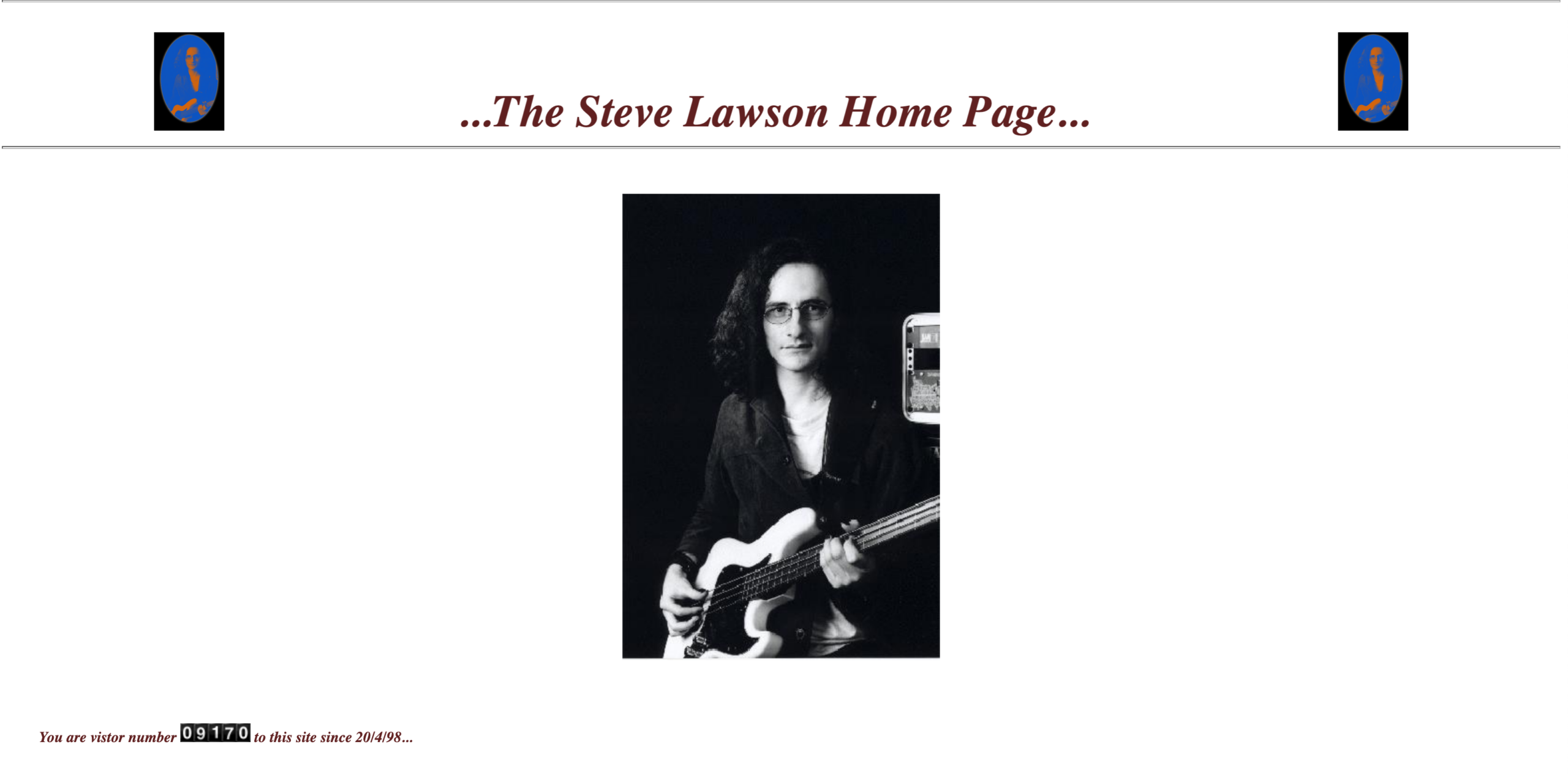
As you can see here… though to be honest that might just indicate that that was when I added a visit counter to the front page 🫣


Back in 1998, being a bass player and bass teacher with a website was a vanishingly rare thing. I didn’t own a ‘proper’ URL for another year or so, but using the free space that came with my email account and some HTML skills learned from pre-Google websearching (probably on Altavista), I built a shop window for everything I was involved in at the time:
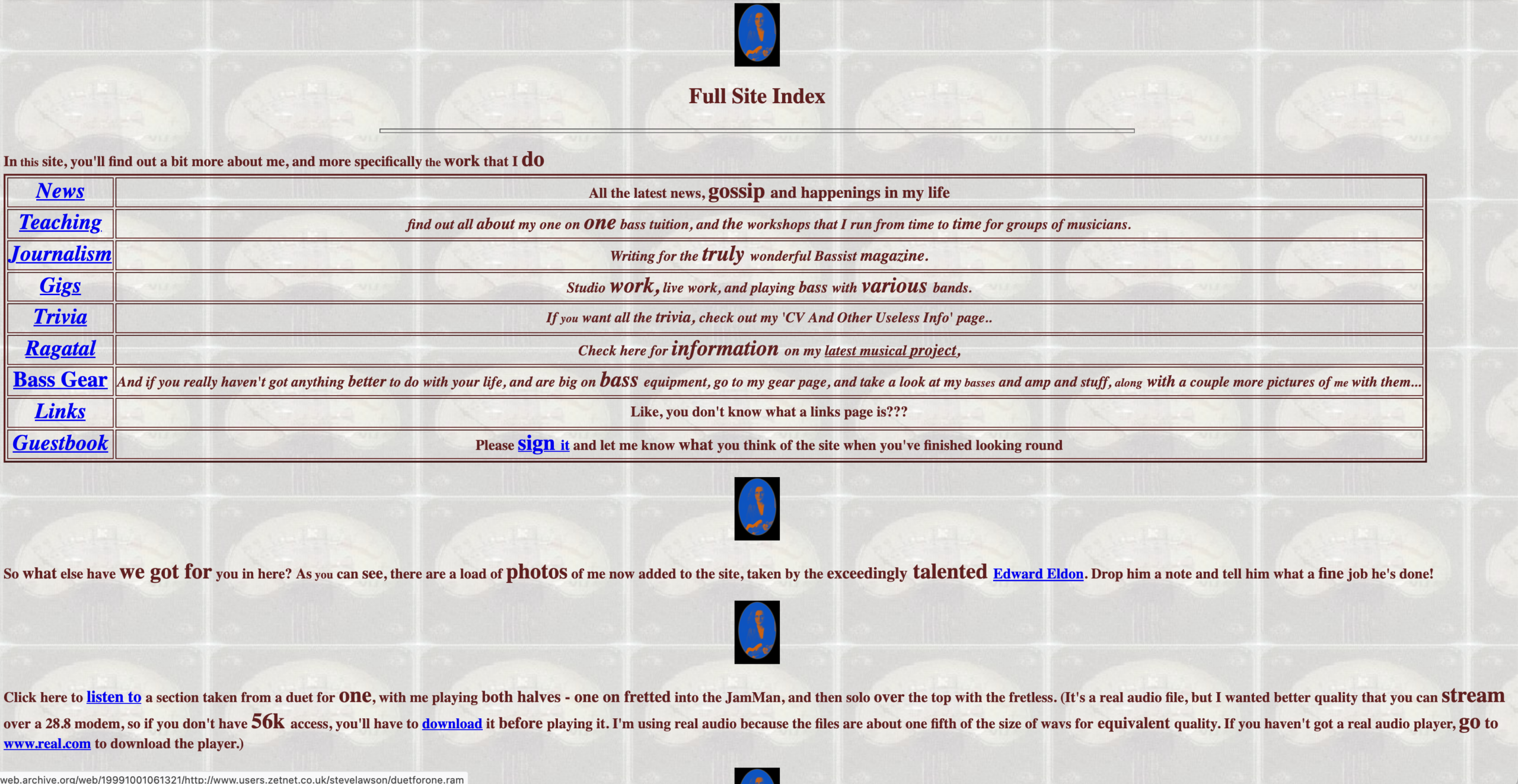
…Just marvel at those design skills 🤣

My first attempt at blogging was before it was called blogging, when inspired by Tony Levin’s tour diaries, I kept one of my own for the tour I did with Howard Jones in late 1999. I also started posting ‘Real Audio’ files around that time, trailing the emergence of solo material ahead of my first solo gig in Dec 1999.

The community side of things was handled by mailing lists and usenet groups – sharing links and stories on The Bottom Line, JustJazz, Churchbass, The Bruce Cockburn fan list, alt.guitar.bass and just email groups with friends. It was another year or so before Talkbass came along, similar time frame for my own mailing list and even the guestbook on my website.

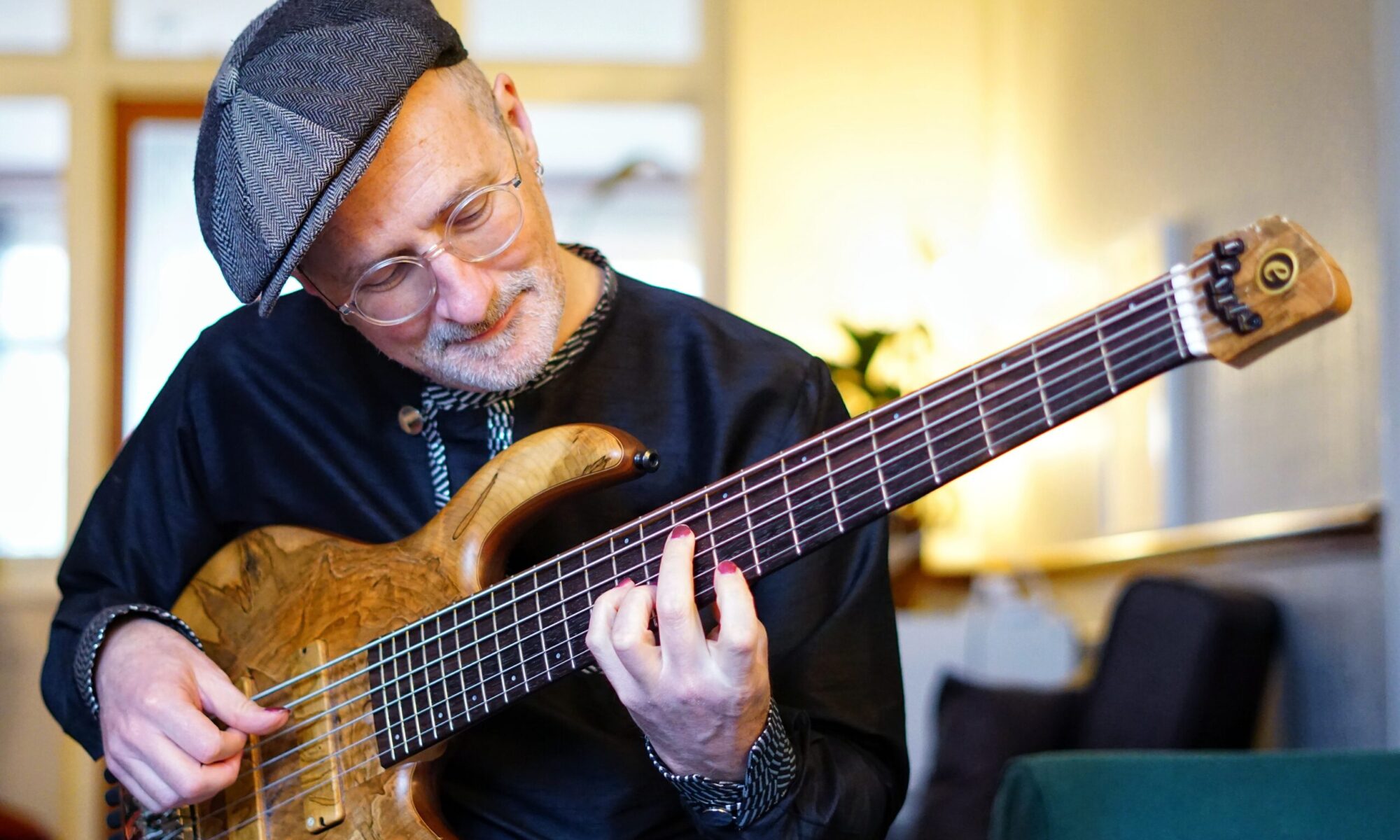
Anyway, here we are 28 years later, and thanks to a lot of support from my webhost, I’ve finally regained the ability to upload photos to this site, and yesterday, before I realised today’s anniversary status, I was able to update all the pics on my site to the new photoshoot. There are still ongoing design tweaks happening, but I’m pleased to be moving again.

Why Still Have a Website?

It’s a good question in 2026. We’ve faced 15-or-so years of Tech conglomorates steering us away from ownership of our own data, of our own audience, of our own creative work towards them hosting, curating and charging for access to everything. The latest to more fully succumb to the pressure is blogging, with everyone starting ‘a Substack’. Newsflash, there’s no such thing as ‘a Substack’ – it’s a website that hosts blog posts. Stop trying to make fetch happen. But by nouning their own site, Substack have more successfully colonised blogging than the previous attempts by Medium, and before that Live Journal/Tumblr etc.

But the shift away from our own sites having traffic and sharing audiences between us was even more calculated than that – Google Reader launched in 2005, and became the market leader in RSS feed aggregators – you could subscribe to blogs, and they all appeared in your Google Reader like a chronological newspaper. No filtering that wasn’t your own (you could group things by subject), it was an amazing way to combine news from agencies, your own friend group, and specialists in your areas of interest.

In 2013, when they shut it down, it coincided with a shift to a lot of people posting shorter form text content on Facebook. Facebook pre-algorithm hoovered up a lot people’s mailing lists and readership by giving the impression of a meritocracy. There were bands with active mailing lists of thousands that moved everything to Facebook, built it into the size of audience that warranted international touring only for the first wave of algorithmic filtering to kick in and them to drop from 10s of thousands of views on every post to hundreds. Literally. Tours were canceled, careers put in jeopardy. And Google Reader shut off the market leader in self-curated blog aggregation. RSS feeds and buttons slowly began disappearing (fun fact: before I had a Twitter account I used to follow various friends’ Twitter feeds via RSS!) and various platforms came along to add algorithms and data-harvesting to the Blogosphere.

Medium did pretty well, and LinkedIn still soldiers on with bizness focused tedium, but it’s Substack that seems to have properly stuck. The advice for musicians shifted away from ‘make sure you have a website and post content there’ to ‘make sure you have an email list’, but the metrics for email open-rates have dropped dramatically over the years…

What’s rarely acknowledged in all of this is that part of the reason and motivation for many of these shifts is that the sheer volume of stuff being produced has ballooned far beyond the scale where everyone whose work warrants an audience can have one. More and more stuff fighting for our attention means less and less attention space for each post, each video… So photos and memes win because those are what we can consume in the largest numbers, that trigger the highest number of swipes and can therefor generate the highest amount of user data to be sold on to advertisers.

Those of us who were part of the great social media adventuring of the late 00s built audiences and explored the potential for community and the dissemination of art and ideas while we were unwittingly training the algorithms of the sites we thought were going to save us. For musicians, online discovery felt like the new frontier. Bandcamp gave us (and continues to give us) control over the sale of our own work, and social networks invited us to build networks and communities by talking about other people’s work, by link sharing, planning tours together, putting on shows and generally talking in a human way at digital scale. But the moment Facebook and Twitter had enough data gathered to know where the value lay, and what they could charge for access to, they closed the road and set up a tollbooth for access. Various attempts came along to build networks without that intervention, from Diaspora to app.net, Mastodon to BlueSky, with varying degrees of stickability. But in terms of global reach and influence, the VC funded, algo-driven platforms are overwhelmingly dominant, from Facebook to Spotify, Substack to Instagram and YouTube. Control over what we want to see in mainstream spaces is largely illusory.

And now on top of that those same sites are littered with AI generated posts, full of inaccuracies and outright lies, fake photos and made up histories, posted for no reason other than clicks. Not to inform, not even to build a community, just post a link to a ‘buymeacoffee’ as though typing a one line prompt into ChatGPT and posting the slop that comes out is worthy of our patronage. It’s content that serves absolutely no purpose in existing, contributes nothing, and just saps attention from things that are accurate. We’d literally just be better off sharing our Wikipedia Page of the Day.

So what do we do? I honestly don’t know. I have my own small acts of resistance. Blocking accounts that post AI slop, refusing to use it for anything (and there are a number of tasks in my life that AI would probably make easier), but also, so far, resisting the pull towards Substack, towards outsourcing the audience for my own writing. My readership here is vanishingly small compared to my social media readership. I’ve just spent an hour writing this, expecting a handful of people to read it, but those who do will be here for a reason. Not bored, not in need of distraction, not served it by an algo. Just here to find out what’s going on.

So I write with intention, create music with intention, teach with intention, and as best I can resist the pull to weaken and diminish any of those for greater reach.

I don’t know where any of this lands, whether the future is human, or whether a refusnik AI-and-algo-resistant community finally coalesces around Artisinal Digitalism – not a descent into analog nostalgia, but a commitment to disseminating work and thought and experience and wisdom through digital means. I don’t want to have to press vinyl or print a fanzine to pretend that physical containers make the work they contain more meaningful.

I just want to find a way to continue to make music and write words for people who care about them. Hopefully you’re along for the ride. 

Thanks for reading. If you haven’t already, please do check out the Bandcamp subscription – it’s literally the only funding model I have for my music work: Click here to find out more.
2008 in review – Blog posts for musicians, Pt 1

Photo by Christian Payne AKA DocumentallyIt’s been an amazing year for me – a proper round-up of the year will be coming soon. But I thought that first I’d pull together some of the things I’ve blogged about this year. So this is part 1 of a compilation of links to my blog posts for musicians this year –

Back in May/June, I did a series of posts about Social Media for Musicians:

…ah, clearly i didn’t finish that last one… 🙂

Then in July, I did a series on my thoughts on bass teaching, and music teaching in general:

These had some really great comments off the back of them…

And here, in roughly chronological order, are my favourite posts from Jan – August:

There you go, that lot would make a pretty good e-book, if I ever get round to editing out the typos, and shortening some of my more overly-verbose entries 🙂

Next entry will cover Sept – Dec, and then the rest of what’s happened this year! If I don’t get to it til tomorrow, have a great new year, see you in ’09!

If you particularly like any of the posts, please share the links around, either via the ‘share this’ option below, or just by forwarding the URL to people who think might like to read them.

Subscribe to this blog via email…

I know, it’s terribly old fashioned, and I’m always complaining about it, but the simple truth is, some people prefer to manage their info all in one place – their email inbox – and that’s fine by me. So here’s the place where you can subscribe to this blog via email, and have each post sent to you automatically. How cool is that?? Just fill in the form below, and each post I upload will be sent to you! Simple as…

Enter your email address:

Delivered by FeedBurner

(of course, it goes without saying that your email won’t be used for anything else, by me or anyone else.)

Creative blogging.

I was recently invited to contribute to a blog on a site called Creative Choices – the focus of the site is resourcing and encouraging people either in or looking to transition to employment in the creative sector. So a few us social media monkeys have been co-opted to blog about creative things. It’s a fantastic remit, and I rather like the look of the site. I’m also in great company, as the other contributors include some of my favourite thinkers in the social media world – Christian Payne, Lloyd Davis and Mike Atherton, amongst others.

Anyway, it’s just gone live Here, and you can read my first post over there, entitled Employ Yourself. It’s one idea that I’ve used in the past to try and get round the feeling that I’m not up to the job of managing the non-bass-playing part of my career… You may find it useful, and there’s a question at the end you can answer in the comments, if you like 🙂

The great "Twitter-Buzz experiment"!

OK, here’s the plan – I’m interested to see how much of a buzz a modest number of twitter-followers can create about a particular site/service/artist/whatever, so I’m running a competition, in which y’all get to come up with whatever ideas you like to send your twitter-readers back to my site, or to my videos on youtube, or music on last.fm. You could pick a fave song, video or blog-post and link to it, you could use it as an example of something, you could even just tell your twit-friends about the experiment (this isn’t a clandestine thing at all!) – it’s just to see how well twitter works for generating buzz…

The key to this is that a) the links are put on twitter, b) you use http://twurl.nl to shorten your url, and c) you tweet me the shortened url so I can retweet it and be able to follow the number of times its clicked as a result.

And yes, there will be prizes, which will include a few of my CDs, and some never-before-heard unreleased stuff, as well as previews of forthcoming albums (again, unavailable anywhere else) – a lot depends on just how effective the competition is – there’ll certainly be a top prize for the most amount of ‘buzz’ created, as measured in number of people clicking your link, which can be to a blog post, or some of the media, or the front page of my site, or whatever, and you can get other to re-tweet the same link, and it’ll count as yours…

If the results are interesting (and I’ll publish them all here), we’ll try the same with blogging about it, and then again with embedded widgets, with stumbleupon, and so on, and see if we can find which is the most effective form of ‘buzz creation’. And hopefully everyone will win – you’ll have some fun coming up with interesting ways to point people to what I do, I’ll get lots of new visitors to the site, a few people will get a load of great new music for nothing and we’ll all find out a little more about how this works. Oh, and whoever wins can write a guest-post here, outlining what they did… Does that sound like fun? Feel free to register your intention to join in in the comments below, then get tweeting.

Remember:
1. Use http://twurl.nl to shorten the URL (web address – you paste the address into the right field on the site, and it gives you an alternate one, that’s easier for me to track)
2. link to my website, a blog post here, a last.fm track, youtube vid, my myspace or reverbnation page.
3. only link to it on twitter
4. direct message me on there with the URL so I can retweet it, and then track it via tweetburner.
5. sit back and watch the prizes roll in.

Social Media Thoughts Pt 2 – The Playground Of The Curious.

I wrote off the idea of chasing a record deal before I even put out my first album. After a series of pretty uninspiring encounters with labels via artists I was working with in the 90s, and the simple fact that as far as I could see, no-one was making any money via a label playing solo bass, I decided before my first album that I’d do it all myself.

Back then, there was a lot of nebulous, unfocussed talk about how the internet was going to change everything, but so much of the traffic that musicians were getting back then was as a result of there being precious little about music online. As an example, I was the only bass teacher in Europe with a website for over a year when I first set my site up, and would get student enquiries from all over the continent, from bassists wanting to fly to england for lessons!

The bass-stuff on the web was pretty limited, and as I had a site, was teaching at a London music college, was involved with The Bottom Line (by far the biggest bass-related web-thing around in the 90s) I had a profile. So when I put up some real audio files (real audio!!) of my first solo gig, it got a surprising amount of traffic and interest. Not because it was the greatest thing ever (only some of it was 😉 ), but just because of the huge amount of novelty-driven, bass-related web traffic that was passing through my site. If I gave people something to do online for half an hour that felt vaguely worthwhile, then my site validated the time they were spending on this great new toy of theirs.

But the tools weren’t really in place to build a career online, just a reputation. However, it was a great environment in which to forge a model for dealing with promoting hard-to-pigeonhole music online – the model being one of curious play – whenever I came across something new, I jumped in and had a play. I chatted to the current users of a particular forum or chatroom, I posted music clips on MP3.com (where unbeknownst to me, Lobelia was racking up over a million plays!) and splashed around in the web-pool, looking for interesting things to happen…

So as social media evolved, my play-approach helped me – along with a whole load of other musicians disillusioned with ‘the mainstream’ – fairly unconsciously develop a way of engaging with my audience via conversation, interaction and availability, rather than broadcast, spam and rock-star seclusion. Again, web forums had been doing this for a while, and I had hosted a forum at talkbass.com in their ‘ask the pros’ section for ages, but Myspace, commentable blogs and self-hosted forums started to make that kind of conversation portable to our own branded space via the comments option.

I remember in the early days of MySpace hearing the rumours that some big name musicians were actually running their own myspace pages, and being nonplussed by everyone’s surprise. Why wouldn’t David Byrne or Robert Smith or Peter Hook or whoever want to communicate direct with their audience? The problem for them was that Myspace got so big that the interaction become meaningless when they received thousands of comments a day. The smart ones started blogging on Myspace, and eventually (years after the novelty value had passed) myspace started promoting celeb blogs… (even then, a lot of musicians kept writing their blogs in the third person, as though a PA was doing it for them, not getting how important it is for audiences these days to hear your story in your voice…) Blog comment threads became a great way for big name artists to ‘host’ the discussion about their thoughts and writing without having to answer individual queries and comments.

The big mistake that so many musicians make with Social Media is to see it as a stop-gap, as what you do ‘until you make it’, as the thing that bands do who can’t get ‘a proper deal’. The lure of becoming a millionaire rock star is still so inexplicably strong that it blinds most pop and rock musicians to the opportunity staring them in the face to bypass all that other BS altogether.

The bit they’ve got lost in is the feeling that broadcast is where its at, is the measure of success, rather than grasping that all but the most refined of broadcast media have an incredibly low recognition ratio for stuff that’s played in the people listening. The simple fact is that I’ve sold WAY more CDs to the coupla hundred people who’ve seen me play in, say, Petersfield in Hampshire, than I have to the hundreds of thousands who’ve heard me on The Late Junction on Radio 3 – a show that’s been playing my music pretty regularly over the last however many years.

What Social Media allows artists to do is have the kind of in-depth conversations that previously could only happen at live events, with their audience in their own homes. If I post here on the blog, the people who are interested in what I do can read it and understand what I do in a way they’re never going to get from the lovely Verity and Fiona giving it a 15 second intro at midnight on the radio. And with so much music the story around the music is what gives it context, and provides and entry point for the audience, an understanding of where the artist sees their music. painters, photographers and sculptors have been contextualising their work within narratives for years, but for any music that is assumed to be in some way ‘pop’ music, it’s tough to get people to do the digging. Social media allows us to place the conversation about what we do right alongside the art itself, inviting responses, questions and discussion.

The future for musicians is in the artist/audience conversation and interaction that social media facilitates. And this is a concept that is now spilling over into business and PR and Marketing and even politics… but that’s Pt III. 🙂

A new review…. of And Nothing But The Bass..??

It’s amazing what you can find looking at your web-stats – I was browsing through mine, seeing who had linked back to this site, and found a review just posted on a blog in January of this year, of And Nothing But The Bass (my first album, for those of you a little late to the party).

A little browsing round the blog in question – jamscience.blogspot.com – showed that it was a review that the writer, Ian Peel, had written for Record Collector magazine!

So those of you that have the CD of And Nothing But The Bass – whether you paid for it, or picked up a free copy at the Social Media Cafe on Friday – have a genuine collectors item in your possession! 🙂

Anyway, you can click here to read the full review. The choice quote from it, that will be appearing on a poster near you soon, is “one of the most gifted solo bass players on the planet” which is always a useful thing to have for a press release. 🙂

If you want to listen to And Nothing But The Bass
, you can do so at last.fm, or you can buy the download version with the extra tracks mentioned in the review, from the online shop here, or from Amazon, or from Cdbaby

New site, new blog home, new shop…

As you’ll have seen by now (unless you’re reading this in an RSS reader), there’ve been a lot of changes round here – the design of stevelawson.net has now shifted into wordpress, the shop is still zencart, but has been given a facelift and most significantly, the blog is now hosted here too, integrated into the rest of the site.

The task of getting everything to forward to the right place was pretty huge – given how highly this blog indexes in google, it was vital that all those link redirected properly to this one, and I had SO much help from my herd of sure-footed trusty geeks: James Stewart, Rev. Gareth, Mike Arthur and The Captain. Gentleman and scholars to a man. I now fully understand why properly trained geeks get paid so much money – they can save you so much money. James did a couple of things this afternoon that quite literally saved me 3-4 complete days of editing URLs and stuff…

The tags from the old site still haven’t copied across, and a lot of the little pages that are littered around the old design still need to be imported and linked to (old gig reviews etc), but we’re getting there, slowly.

I hope you like the new design. Feel free to try out the new shop – if anything does go a bit weird, just email me, and we’ll sort it out – there’s no way you’re going to lose money on the deal, cos it’s actually me who runs it, so if there’s a problem, I can just FTP you the files for the download or pop a CD in an envelope, no worries 🙂

Enjoy…

Exclusive track on Reverb Nation + gig news…

I’ve FINALLY got round to adding the latest bunch of gigs to Reverb Nation. The first of which is this sunday, at the Brickhouse, on Brick Lane in London (deets below in the gig cal widget).

The gig’s with my new trio with Patrick Wood and Roy Dodds – two of the most amazing musicians I’ve ever had the privilege to play with. I’ve just added a fan-exclusive track to the Reverb Nation page, which you can play from from the widget below if you’re already on the mailing list, or you can just sign up! Enjoy…


Steve%20LawsonQuantcast


Steve%20Lawson
Quantcast

Interaction, Conversation, Respect: the death of broadcast marketing on the web…

I’m just back from a visit to Internet World – a trade show/expo at Earls Court for internet business peoples. It sounded interesting, so I thought I’d head down for a look.

I guess it didn’t help that they were sharing the hall with a direct marketing expo, but the feeing that one was in the belly of mammon, in a space largely devoid of creative thought or concern for human interaction and anything other than statistical dominance in a given field was pretty overwhelming.

Actually, that’s not strictly fair. A lot of the companies there were touting content management software, e-commerce solutions (no bad thing in an of themselves) and a couple of speculative social networking start ups. But there were loads that were selling a model of internet usage that just seemed sooo archaic – the basic message still seemed to be that it’s all about emailing millions of people, getting to the top of the search engines, getting google adwords in the right place, and then whatever you’re doing online will be a success…

I suppose it’s the nature of the show that it can’t really be concerned with content, because the content could be anything from health information to porn, ethical shoe-shops to online gambling, but the total lack of any visible discussion about making the net a nicer environment in which to work and play, the focus on spreading ones marketing message by whatever means made for a pretty sickly experience (I had one bloke accost me in an aisle and ask me if I wanted to buy email addresses! WTF? So spammers now have their own stands at expos??)

Bottom line was, the expo looked for all the world like a shop front saying ‘for your business you don’t have to interact with your audience/community/end users; you just have to pay us stacks of cash to put together a slick looking site for you, virally market via BS videos and downloadable games, crass adverts and paid-for email lists, and you can get on with being scared of the web and thinking Myspace is the big news in the future of internet usage, safe in the knowledge that we’ll sell any old crap just by spamming so many people that one click in a million will yield results…’

Which is bollocks. And it’s bollocks despite it supposedly ‘working’ for a lot of people. It’s bollocks because it’s intrusive in its methodology, hopelessly inefficient in terms of the amount of hours of people’s time it wastes compared to the return (time spent filtering out unwanted email, watching endlessly forwarded viral nonsense etc.) and because it’s a distraction from what those of us who actually CARE about a) what we’re producing and b) the environment in which we live and work on line actually need to do to enhance the lives of the people who come into contact with what we do.

I’m not in the marketing business. I USE elements of marketing strategy to try and make my music – and information about my music life – available to the people who want to find it. I don’t want to have to send unwanted emails to 1,000,000 people in order to reach 600 who might like what I do. Even though those are 600 people who might otherwise not find it. Why? Because I’m sick of being one of the 1,000,000 people who get spammed with BS hundreds of times a day just on the off-chance that my address might lead to someone who’s interested in the product. That ruins the web for all of us. And I don’t really care whether the address list is pure (illegal) spam, or some kind of crappy opt-in list that’s 99.9% full of people who just forgot to click the right check box, it’s still generating way too much negative web-karma for it to be of interest to me.

I try to operate online the way a rather wise man once suggested we carry out all our human interaction; ‘treat people the way you’d like them to treat you’. I don’t want to be spammed, I don’t want my email address to be a salable commodity, I don’t want to be seen as part of a wall to throw mud at in the hope that some of it sticks.

Here’s where Social media comes into its own – I can set up an interconnected network of pages, sub-communities and widgets whereby anyone who is interested can find my music, try it, engage with it on whatever level they want to and then share it with others if they think it’s of value. I’m not throwing it at them, I’m asking them if they’re interested, and offering information about the how, what, where, and why in as many mediums as I can. I can do videos explaining my methodology, I can blog about the processes involved in the music making, I can provide widgets so people can share my music with people who visit their sites or blogs or facebook pages or whatever if they are interested, and each time it’s driven by real interaction.

There’s the scattershot stuff as well – Seth Godin posted this great piece about unfocussed web-traffic – sure it makes us feel great to have 10,000 visits a day, but in all honesty I’m much better off with the coupla hundred people who actually read my blog each time I post over and above the thousands who have found my blog over the years looking for stuff about David Beckham or Bernie Clifton. They, as Seth points out, are gone in a couple of seconds.

That’s not to say that search engine traffic is bad, or stumble upon, or even adwords or whatever. The problem comes when the purpose of your site/blog/enterprise is traffic. Where what you’re making becomes about getting people to look at it, download it, buy it.

The joy of social media is that it removes the need to obsess over ‘bigger better faster more’ – it allows us to focus on deeper, richer, more important, personal, engaging, thoughtful, nuanced creation than we ever could have if we were relying on record companies, radio, TV and newspapers to spread the word about it. In the language of barcamp, it enables us to engage in UnMarketing. To tell the story around our art, our creativity, or lives and our services, and allow an informed, liberated audience to choose whether or not they want to be a part of that, and on what level they want to be a part of it.

There are loads of ways in which internet professionals can help content providers – this isn’t a rant against web designers, CMS companies or e-commerce specialists. We just need to get our priorities right, and if art is of any importance to us, then the marketing should be there to connect with a willing, searching audience and free us up to do our art better, not force us to dumb down in order to fit some loser’s ‘projection’ of the kind of big money we could make if only we targeted our content a little more specifically ‘Steve, you could clean up in smooth jazz, if only you’d get a quartet and start grooving more….’

Keeping our sights set on that which made us want to get into art/music/creativity in the first place is vital to understanding the magic that social media can facilitate. That means keeping a tight rein on those who would seek to make your art the content that drives their business venture… Or at least being honest about that relationship and understanding it for what it is (again, before I get accused of being some kind of purist, I don’t have a problem with people who make music commercially for a living, or indeed an objection to making commercial music where people want me to do it, it’s just that it’s a WHOLE other world to making ‘me-music’, and requires a very different approach…)

So for me, the kind of marketing-driven, spammalicious devoid-of-community BS I was hearing at Internet World fails in every way that the Social Media Cafe succeeds. I’ll blog more about the SMC later, as it deserves its own post, but suffice to say as a community of webby social media lovelies, it’s provided me with more inspiration, information, connections and ideas in the upstairs room of a pub in soho than the amassed fortune spent on Internet World could have done if I’d spent all three of the days there trawling for quality…

Top
