
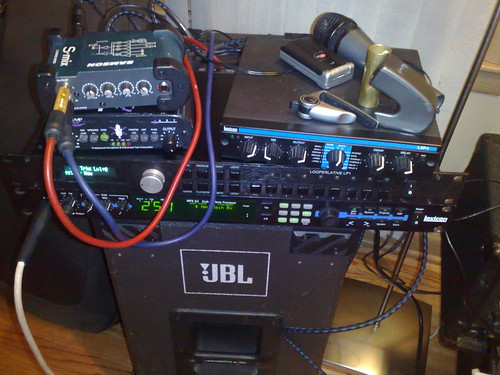
 Looping is no longer a gimmick. It’s official. If it’s your gimmick, find a new one. It’s way too mainstream to be a cover for crap music any more.
It’s all happened fairly recently – back when I started doing solo gigs (late 90s) it was a fantastic gimmick. Fortunately I never relied on it being such, or I’d be screwed now, but it had a certain freak factor that was appealing to certain audiences.
Now everyone and her dog are looping, so it doesn’t work as a gimmick. Which is fantastic news. Really, really great news. It stops crap tuneless musicians from doing mindlessly repetitive gigs just because they’ve bought an esoteric bit of kit and can impress a few gear-geeks with it. One nil to the audience; oh, and learn some tunes, crappy-looping-dude.
However, what hasn’t changed since looping went mainstream is the conversation about it. Both from the vast majority of the musicians using it and from the manufacturers, the basic statements about what it is and what it does – and what it gives you – are the same as they were years ago;
- that it’s about recording a bit of audio that goes round and round and round until you stop it at the end of the song.
- That the longer the loop time you have, the better the box you’re playing with.
So the digitech jamman gives you up to 6.5 HOURS of loop time, but still has most of what few functions it has applied in such a way that they only work in ‘step-time’ – ie, you have to stop the loop, or at least interrupt your performance to the point where you look like a bit of a twat on stage in order to be able to do them. (Ironically, the original Lexicon JamMan, with its 32 seconds of loop time, was an infinitely better looper than the Digitech…)
Here’s a list of things that the gear manufacturers seem to think people want –
- internal metronomes that play through your amp
- quantise functions
- massive amounts of loop time
- amp simulation
- the ability to get rid of mistakes, but not undo layers
- only two buttons to work with
- removeable media
And what’s weird is, if you’re the owner of one of the lower end loop boxes, who bought it after seeing an ad for it, you probably agree with the stuff on that list. Even though what they amount to is a glorified mini-disc recorder with foot controls, and a practice tool that stops you learning how to actually play your instrument.
Lemme explain –
Internal metronomes – What use is an internal metronome? For one, it plays through the outputs, so if you hear it your audience hears it. That’s crap, no-one wants to listen to a click track. Secondly it suggests that looping works best when it’s in time. It doesn’t. Thirdly, it suggests that even if you want it to be in time, you need a click. You don’t, you need to practice.
Quantise functions – Why quantise? No idea. All it does it mean that you don’t learn to loop in time, and most importantly you don’t know what’s going to come out when you loop it. You don’t know because you’re not in control of how it works. Something else is. It’s the death of anything spontaneous about looping, and looping without the option to be spontaneous is like gigging with a backing track. ie, largely, shit. It also requires you to have a metronome on, see point above.
Massive amounts of loop time – Surely that’s a good thing? Well, yes and no. It’s not in an of itself a bad thing. It’s using it that’s a bad thing. REALLY long loops are very, very hard to make interesting, especially if you’re playing solo. I’ve heard a few people do it, I’ve heard very few (one or two) do it well. None of them were using RC-20s or JamMen. The advertising says long loop time is great for saving lots of loops. But saving loops is a curates egg. It’s great if you want to be able export them and remix particular things. It’s crap if you start using pre-recorded stuff because you think you’ve got the perfect take and don’t want to risk getting it wrong. Because of this last point, pre-recorded loops are, by and large, the death of creative aspiration. (the qualifications in my statements about pre-recorded stuff are because there are a handful of artists doing REALLY interesting stuff with prerecorded material. They are however, overwhelmingly the exception rather than the rule).
Amp simulation – Again, not a bad thing, just not the kind of thing you can do with any level of sophistication at the push of a button on a £200 loop box. Amp Sim = roll off the high end, boost the midrange. get an amp or a proper amp sim, or learn to live without it.
The ability to get rid of mistakes, but not undo layers – OK, this really is a biggie. The way the undo works on the RC-20 is that you hold down the footswitch for 2 seconds and then it deletes the last layer. Possibly the most unmusical interface ever in an effects pedal. Totally useless bollocks, based on the assumption that removing layers is about getting rid of mistakes when step-time building a loop, not about arranging a piece by putting layers in and taken them out. We’re back to the mini-disc concept of looping. It’s rubbish, it’s annoying, and it needs to change.
Only two buttons to work with – I kinda understand the need to make the RC-20 meet the floot-print of the other Boss pedals like it. It’s just that they crippled the user by doing it, and end up with shit functions like the one mentioned above. You can’t do proper interactive loopage with two buttons. It doesn’t work. The JamMan allows you to plug in another pedal, but infuriatingly it controls a load of step time functions for recalling prerecorded loops!!! ARRRGHHH! Why not have reverse? Why not have ‘next loop record’? You utter morons!
Removeable media – Again, a curates egg, like loop time. Nothing wrong with it, just not something that is ever going to be particularly good if you can’t also record an entire performance into it, and export each layer separately. That would be a great use of removeable media. But nobody does it.
So what’s missing? Conceptually, the notion that loops are static is really, really restrictive. Unless you just write very simple, beautiful repetitive songs, looping needs to be interactive, because it’s the interactivity stops the audience from ‘learning’ the loop. As soon as the audience knows exactly what’s going on with the loop, it becomes a backing track. That’s why on tracks like Grace and Gratitude and Behind Every Word the timing is so stretchy. It’s really difficult to get a handle on predicting exactly where the loop is going to come back round, and means I can build rhythmic tension and ambiguity into the melody. It also, crucially, keeps me listening on a much more intense level, because I haven’t learned the loop shape exactly first time round, I’m interacting with it the way I would another musician.
So how does one interact with a loop? Well, the simplest way to do it is to stop and start the loop. Record something, play over it, then stop it and play something else, then start it again. Hurrah! interaction, human decision making, audience interest. Any of these boxes can do that.
The second level is overdubs. You don’t have to do all your layering at the start! A simple ‘AAAAA’ form tune can be made way more interesting by starting simple and adding bits as you go along – again, have a listen to Grace and Gratitude – on the album version there are three layers, which come in progressively through the piece, and then a load of post-processing of the loop (all live) which I’ll get to later…
However, with overdubs, it’s also nice to be able to take them away again. The Akai Headrush does this in a really cool musical way – the undo removes everything except the initial loop, and it does it the moment you hit the pedal. It’s great, it’s musical, and I could get more mileage of of the 11 seconds I get with the Headrush than the 4 years of loop time in any of the others… would be nice to have a little more than 11 seconds though. :o)
Third level is fade-outs, which can happen in three ways – manual volume control, pre-programmed fadeout or feedback control. The Line 6 DL4 allowed for a manual fade out, thanks to the expression pedal socket – you could set it so that as you fade the loop out, the delays over the top got louder and the feedback on them increased, which is a fantastically musical option (have a listen to any of the looping Theo Travis has been doing of late to hear that effect…) – Pre-programmed fades are a pain in the arse, because again, you’re relinquishing control, and losing your own touch on the detail. and IT’S ALL ABOUT THE DETAIL.
If you ever get a chance to go to a classical masterclass with a world-reknowned master musician, do it. Doesn’t matter what instrument. What matters is what it is the sets them apart. In my mid-20s, I thought I was the bollocks, thought I was a really shit-hot bassist. Then one night on tour, I watched a televised cello masterclass. The dude giving it had the student play through the piece – I can’t remember what the piece was – anyway, she was fantastic, and my first thought was ‘what the hell is he going to say to critique that??’ Then he started to pull it apart. He was pretty gentle in his words, but he deconstructed almost every element of what she did. And when he demonstrated passages, it was like taking off sunglasses when you’ve forgotten that you had them on, and realising it’s not as dark in-doors as you thought… It was a whole other level up, BUT, that level was probably less than 2% of what was going on. The woman playing the piece was great, at least 98% proper great. But that 2% counts. The control, the detail, the focus, the hours and hours of practice. And pre-set fade-outs aren’t in that 2%.
So to feedback. Feedback is the single most undervalued parameter in a looper. I know because I was utterly clueless about it for years, to the point of suggesting that my set up with the jamman was fine and I didn’t need an Echoplex because feedback could be simulated by doing fadeouts with a volume pedal.
Bollocks it can. (never let it be said I’m unwilling to admit when I’m very slow indeed at getting my head round things…)
Feedback, put as simply as I can, is control over the progressive decrease in volume of the audio in a loop, by a certain percentage each time it comes around. So if you’re feedback is set at 70%, the second time round will be 30% quieter than the first, and so on, until it fades out.
What’s really important about feedback is that stuff you overdub while it’s fading is still coming in at 100% – if you fade it by volume, everything reduces at the same rate. If you use feedback, you can get the effect of layers receding into the distance. Have a listen to Ubuntu, Need You Now or No Such Thing As An Evil Face from Not Dancing For Chicken – that was me discovering the joys of feedback, and the subtle evolving textures work really well.
None of the cheap loopers have feedback, not even the RC-50 (the Roland website hilariously states “The Ultimate Looper Has Arrived” – but then forgets to link to the Looperlative…) A feedback control would change everything for one of those crappy loopers. Just a jack socket for an expression pedal. Please?
Next up on the interactivity list we have changing the form – with the current crop of low and mid-priced loopers, they’re set up to do A/A/A/A/A/etc. or to switch between prerecorded backing tracks. Would it have been so hard to set up the architecture so that if you used the track up button on the JamMan external footswitch and went to an empty slot, it started recording to that slot at the end of the current repeat of the one that you’re on? Apparently, it would be too hard, cos it doesn’t do it.
I’ve done a few tunes with multiple sections – Behind Every Word, FRHU, Despite My Worst Intentions – as you can see I tend to lean towards tracks that evolve rather than ABABABAB, which is why I’d vote for feedback control over switching between loops for recording, but both would be ideal.
Back to how this fits with interactivity, and your connection with the audience – multiple sections give us another way to be unpredictable. The audience doesn’t know when you’ll switch to the next loop, so they stay attentive (assuming the actual noises you’re looping are engaging in and of themselves – x-ref the stuff about gimmicks at the start).
It’s UTTERLY vital that your audience feels like anything could happen right up to the end of the song. Even if they know that you’re likely to play the song in it’s usual form, they need to feel like they’re part of something unique. The gig I did at The Spitz a few weeks back opening for Max Richter and Hauschka was a really interesting one for me, and hopefully for the audience, because I used each of the tunes as a springboard for a big improv. Grace and Gratitude was about 40% written content, same for Behind Every Word – both spiralled off, and everyone was rapt. I got a far better response that I thought I would have done on the gig, and life was marvellous, if only for a moment.
This is all before we’ve got into varispeeding, reversing, scrambling, replacing, selective overdubbing and generally fucking about with the loops in a way that the Looperlative, Repeater, Echoplex and the various software loopers can. We (we being the loopers who aren’t happy with glorified minidisc) owe a huge debt of gratitude to Kim Flint and Matthias Grob for the work they did on the Echoplex – everyone else working in this field right now is standing on the shoulders of giants… or at least standing on the shoulders of a Swiss hippie and a geek from the Bay Area.
Thanks to the bureaucratic nightmare that is the Gibson corp, the EDP seems to be on hold at the moment – perhaps because of the fact that it miraculously manages to be that advanced on a late 80s Mac processor, which is both remarkable and very limiting in terms of development without a total hardware redesign. It’s also still mono and relatively low-fi.
The best of the hardware loopers (and I’m not a fan of trying this stuff on a computer – way too much to go wrong, i just don’t trust mac or windows enough to rely on them in a gig…) is definitely the Looperlative – the ethernet port for software upgrades means it’s properly upgradeable, the full stereo signal path and much higher sampling rate mean it’s useful for proper recording, and the fact that it’s basically one bloke doing it all means that while it all slows down if he’s out of action (Bob was ill for a while earlier this year), there’s no focus groups or board members or rubber stampers to get past to make it happen. Bob Amstadt is a truly remarkable bloke for bringing the Looperlative to fruition and I now can’t imagine gigging without it. There isn’t anything that I could even begin to replace it with.
Which brings us to what is probably the single most annoying thing about what Roland and Digitech and to some degree Line6 have done to looping – they’ve turned it into a pedal/effect market when in fact it has the potential to be an instrument. The Echoplex is an instrument, the Looperlative is an instrument, the Repeater is an instrument. They take time to learn, they are subtle, complex, adaptable, interactive, require finesse and taste and get tired very quickly if seen as a gimmick. They reward hard work, practice, focus and conceptual consideration, and can be used to make unique, beautiful, complex engaging music in the same way that a piano can. I’m sure that someone will argue the semantics that because they don’t generate sound they are processors of sound, but my counter to that would be that unlike a processor, for most of the functions on a looper you have to actually do something to get a result – you can’t just plug it in and have it do things to your sound like, say, a chorus or delay pedal.
Because people see Looping as either an effect, or even worse, a toy, they see the Echoplex and Looperlative as expensive. I think £700 or there abouts for a Looperlative is the greatest bargain in the music world since the last time someone found a Strad in a junk shop. It all depends on whether you want to learn it as an instrument or keep ploughing the defunct and potentially embarrassing furrow that a bit of rudimentary looping is a clever gimmick that will get you gigs when your music won’t do it on its own.
BTW, none of this says that you can’t make great music with an RC-20, JamMan or Dl4 – all of them have parameters that can frame your fantastic looping ideas. What they don’t do is point you in the right direction, so you have to do the hard work yourself. Remember that great music is technology independent – the technology will inform it, and facilitate it coming through in a certain way, and even feed into your creative process, but it won’t make your music great, any more than buying a Moleskine will make you a great writer. That comes from practice, thought, process and having a story to tell. Which is a whole other post.